
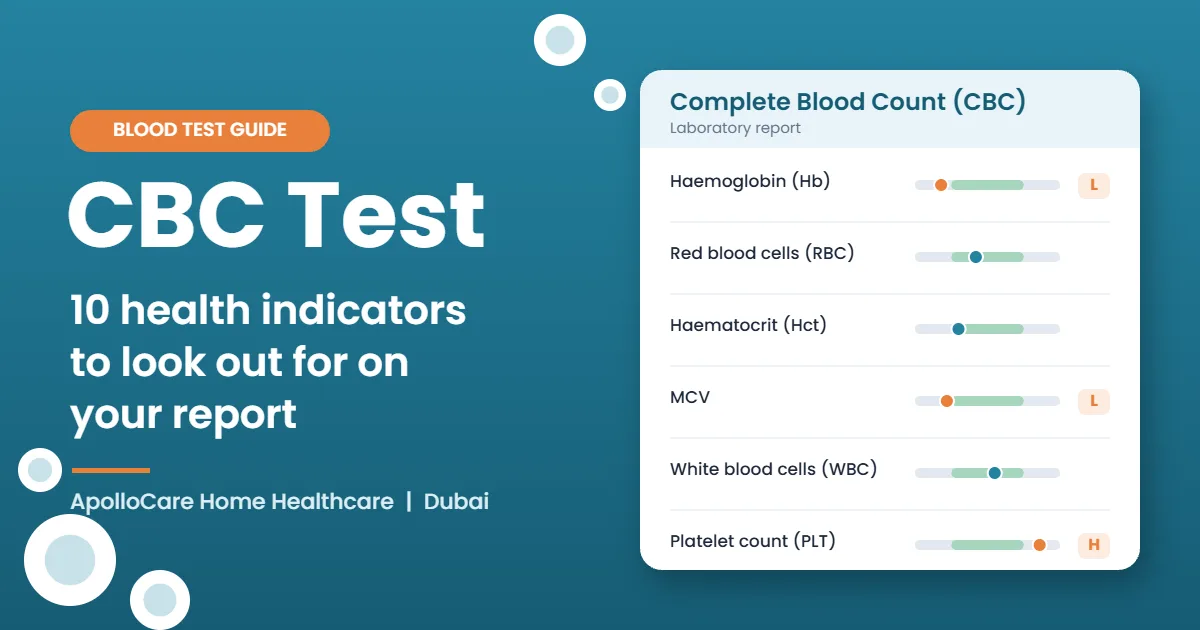
If you’ve ever had a routine check-up, a pre-employment medical or a hospital stay, you’ve very likely had a CBC test. It’s often one of the first blood tests a doctor orders. But the report can be confusing, with a list of abbreviations such as Hb, MCV, RDW, WBC and PLT. The good news is that most results are much easier to understand once you know what each line measures.
Each line tells your doctor something about your red blood cells, white blood cells or platelets. Together, they can point to issues such as anaemia, infection, inflammation, clotting problems and inherited blood traits like thalassaemia.
Below, we walk you through 10 health indicators on your CBC test, what high or low results can mean, and when to follow up with a doctor in Dubai.
Table of Contents
What Is a CBC Test?
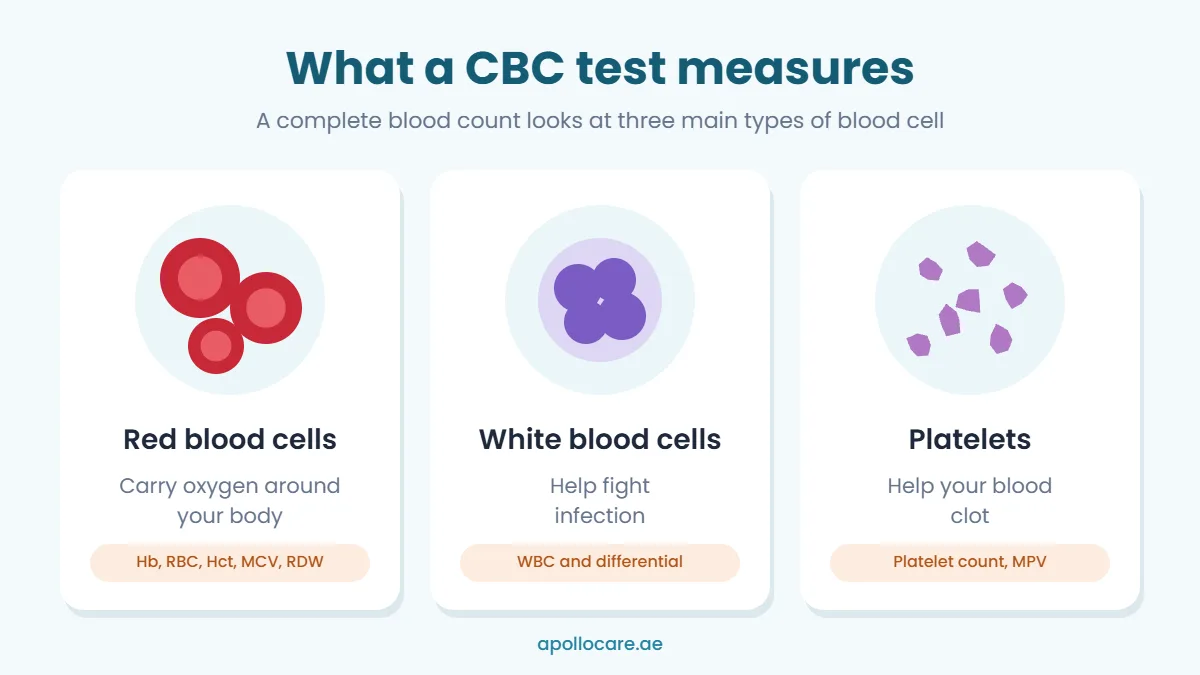
A CBC test, or complete blood count, measures the number, size and features of the cells in your blood. In the UK and some other countries, it’s called a full blood count (FBC). According to MedlinePlus, it looks at three main types of cell:
- Red blood cells carry oxygen from your lungs to the rest of your body.
- White blood cells help your body fight infection.
- Platelets help your blood clot and stop bleeding.
A standard CBC gives your total white blood cell count. A CBC with differential goes a step further and breaks this down into each type of white cell.
The test needs only a small blood sample, usually taken from a vein in your arm. You don’t normally need to fast, unless other tests such as fasting glucose or cholesterol are being taken at the same time.
10 Health Indicators on Your CBC Test
Before you start: reference ranges vary between laboratories, and by age, sex, pregnancy and even altitude. There’s no single CBC normal range, so always compare your results with the range printed on your own report.
1. Haemoglobin (Hb)
Haemoglobin is the iron-rich protein inside red blood cells that carries oxygen around your body. A low haemoglobin level means you have anaemia. This can cause tiredness, shortness of breath, headaches and pale skin. Common causes include iron deficiency, heavy periods, pregnancy, low vitamin B12 or folate, blood loss and long-term illness.
A high haemoglobin level can be caused by dehydration or smoking. It’s also seen with long-term heart or lung conditions, testosterone use and, less commonly, a bone marrow condition called polycythaemia vera (MedlinePlus).
2. Red Blood Cell Count (RBC)
This shows how many red blood cells you have, and it usually moves in the same direction as your haemoglobin. One useful exception: a normal or high RBC count with small red cells can be a sign of thalassaemia trait rather than iron deficiency (see MCV below).
3. Haematocrit (Hct)
Haematocrit is the percentage of your blood made up of red blood cells. It tends to rise if you’re dehydrated, which is worth bearing in mind if you’ve spent time outdoors in the Dubai heat or had vomiting or diarrhoea before your test. It falls with anaemia.
4. Mean Corpuscular Volume (MCV)
MCV is the average size of your red blood cells, and it’s one of the most helpful clues on a CBC test.
- Low MCV (small cells): often due to iron deficiency or thalassaemia trait.
- High MCV (large cells): can be linked to low vitamin B12 or folate, heavy drinking, certain medicines, liver disease or an underactive thyroid (American Family Physician).
Why this matters in the UAE: inherited blood conditions such as beta-thalassaemia are an important health issue here, which is why screening for them is part of the UAE’s mandatory premarital screening. People with thalassaemia trait usually have small red cells but normal iron levels. Iron tablets won’t correct this and aren’t needed unless you’re also low in iron, so finding the right cause matters.
5. MCH and MCHC
MCH is the average amount of haemoglobin in each red cell, and MCHC is how concentrated that haemoglobin is. MCH is usually low when MCV is low, as in iron deficiency and thalassaemia trait. Your doctor looks at these values alongside your RBC count, RDW and iron studies (such as ferritin) to tell the two apart.
6. Red Cell Distribution Width (RDW)
RDW shows how much your red cells vary in size. A high RDW means there’s a wide mix of sizes. This is common in iron deficiency or when there’s more than one cause of anaemia. In thalassaemia trait, the RDW is often normal because the cells are evenly small.
7. White Blood Cell Count (WBC)
Your white blood cell count is the total number of infection-fighting cells in your blood.
- High: most often due to infection or inflammation. It can also rise with steroid medicines, allergies, severe physical or emotional stress and tissue damage. Rarely, it points to a blood condition such as leukaemia.
- Low: can follow a viral infection or certain medicines, including chemotherapy. Less often, it’s linked to autoimmune conditions or a bone marrow problem.
8. Neutrophils
Neutrophils are the most common white cells and your body’s first line of defence against bacteria and other germs. They often rise during bacterial infections. A low neutrophil count, especially during chemotherapy, raises the risk of serious infection. If your neutrophils are low and you develop a fever, treat it as an emergency.
9. Lymphocytes and Other White Cells
These are shown on a CBC with differential.
- Lymphocytes help fight viruses and often rise during viral infections.
- Eosinophils can rise with allergies, asthma, eczema or parasitic infections.
- Monocytes and basophils are smaller groups. Small changes are common, and your doctor will read them in context.
10. Platelet Count (PLT)
Platelets help your blood to clot.
- Low: a low platelet count may cause easy bruising, nosebleeds or bleeding gums. Causes include infections, certain medicines, pregnancy and immune conditions.
- High: most often a reaction to infection, inflammation, iron deficiency, surgery or bleeding. Less commonly, the bone marrow itself makes too many platelets.
Some reports also show the mean platelet volume (MPV), which is the average size of your platelets.
How to Read Your CBC Report Without Panicking
Anything outside the reference range is usually flagged H (high) or L (low). Reference ranges are based on the middle 95% of results from healthy people. This means about 1 in 20 healthy people will fall slightly outside the range on any single test. If just one value is borderline, everything else looks normal and you feel well, your doctor may simply repeat the test.
What matters most is the overall picture. Low haemoglobin with a low MCV and a high RDW tells a very different story from low haemoglobin with large red cells. That’s why a doctor should interpret your CBC test results alongside your symptoms, medicines and medical history. They may also check related tests, such as a CRP test for inflammation or an HbA1c test for blood sugar.
When to Seek Urgent Medical Attention
Get urgent medical help if a problem on your CBC test comes with any of these symptoms:
- Shortness of breath, chest pain or fainting
- A fever while you’re on chemotherapy or medicines that lower your immunity
- Unusual bleeding, black stools or lots of new bruises
In an emergency anywhere in the UAE, call 998 for an ambulance.
CBC Test at Home in Dubai
A CBC test is quick and needs only a small blood sample, so it’s well suited to collection at home. This is especially helpful for older adults, people recovering from surgery and new mums checking for anaemia.
In Dubai, the DHA’s Standards for Home Healthcare Services require every home healthcare professional to be licensed and registered with the DHA. ApolloCare’s Blood Test at Home service uses DHA-licensed staff to collect your sample, and we work with DHA-approved partner labs to process it. Most reports are ready within 24 to 48 hours, depending on the test. If you live in Abu Dhabi or another emirate, check that your provider is licensed by the local health authority.
The cost depends on whether you need a CBC test on its own or as part of a wider panel, and on your insurance cover. Call us for a quote before you book. Having several tests at once? Read our guide on how to prepare for a blood test at home in Dubai.
CBC Test FAQs
Do I need to fast for a CBC test?
No. A CBC test doesn’t usually need any special preparation. If you’re having other tests at the same time, such as fasting glucose or cholesterol, follow the fasting instructions for those.
What’s the difference between a CBC and a CBC with differential?
A standard CBC gives your total white blood cell count. A CBC with differential breaks this down into each type of white cell, such as neutrophils and lymphocytes.
Can a CBC test detect cancer?
A CBC test can show changes that need further tests, particularly for blood cancers such as leukaemia. But it can’t diagnose cancer on its own, and most abnormal results have other causes.
What does low haemoglobin mean?
Low haemoglobin means anaemia. Iron deficiency is one of the most common causes. Others include blood loss, low vitamin B12 or folate, long-term illness and inherited conditions such as thalassaemia. Your doctor may order iron studies to find the cause.
Can dehydration affect my CBC test results?
Yes. Dehydration can make your haemoglobin and haematocrit look higher than they really are. Unless your doctor advises otherwise, drink normally before your test.
How often should I have a CBC test?
There’s no set schedule for healthy adults. Your doctor may recommend one during a check-up, if you have symptoms, or to monitor a condition or medicine.
Understanding Your CBC Test Results
Your complete blood count gives a wealth of information about your health. Knowing what each indicator means can help you ask the right questions, but your results should always be interpreted by a doctor who knows your history.
ApolloCare can collect your sample at home anywhere in Dubai, and you can book a doctor on call visit if you’d like a doctor to talk you through your results. Call +971 50 491 9347 or contact us to book your CBC test at home.
Disclaimer: This article is for general information only and isn’t a substitute for medical advice. Reference ranges and interpretation vary between laboratories. In an emergency, call 998.
Sources
- MedlinePlus: Complete Blood Count (CBC)
- MedlinePlus Medical Encyclopedia: CBC Blood Test
- MedlinePlus: Blood Differential
- MedlinePlus Medical Encyclopedia: Thalassemia
- Cooley’s Anemia Foundation: What Is Thalassemia?
- American Family Physician: Evaluation of Macrocytosis
- NHLBI: Thrombocythemia and Thrombocytosis
- Journal of the American Board of Family Medicine: Interpreting Normal Values and Reference Ranges for Laboratory Tests
- Department of Health Abu Dhabi: Premarital Screening
- Dubai Health Authority: Standards for Home Healthcare Services
- UAE Government Portal: Handling Emergencies
