
You open your lab report and one line stands out: CRP, marked high. Or your doctor has asked for a CRP test after a fever that won’t settle. Either way, you want to know what this number means and whether you should worry.
A CRP test is one of the most common blood tests doctors order, and also one of the most misunderstood. It can tell your doctor that something is causing inflammation in your body. It can’t tell them what that something is.
This guide explains what a CRP test measures, why doctors use it, how to read your result and when a raised level needs prompt attention. It also covers how families in Dubai can have the test done at home.
Table of Contents
What is a CRP test?
C-reactive protein (CRP) is a protein your liver makes when there is inflammation in your body. A CRP test measures how much of it is in a sample of your blood, according to MedlinePlus, the US National Library of Medicine’s patient guide.
CRP belongs to a group called acute phase proteins. These rise quickly when tissue is injured, an infection starts or the immune system is activated. That speed is what makes the test useful: CRP can climb within hours and fall again as the problem settles.
The key thing to understand is that CRP is a general marker. A high result says “inflammation is present”. It doesn’t say whether the cause is a chest infection, a flare of arthritis or a recent injury.
Why might your doctor order a CRP test?
Doctors rarely look at CRP on its own. They read it alongside your symptoms, an examination and other tests. Common reasons include:
- Checking for infection. A fever with no obvious source, a suspected chest or urine infection, or a wound that looks red and swollen.
- Monitoring inflammatory conditions. People with rheumatoid arthritis or inflammatory bowel disease may have regular CRP checks to see whether a flare is building.
- Tracking treatment. A falling CRP over several days can suggest antibiotics or anti-inflammatory treatment are working.
- Investigating vague symptoms. Ongoing tiredness, unexplained weight loss or night sweats sometimes call for a broad first look.
Here’s a typical example. An elderly parent in Dubai develops a fever and becomes more confused than usual. The doctor suspects a urine infection and orders a CRP test with other bloods. A clearly raised CRP supports that picture. A repeat test a few days later shows whether treatment is working.
CRP test vs hs-CRP: they’re not the same test
You may see two versions on a lab menu.
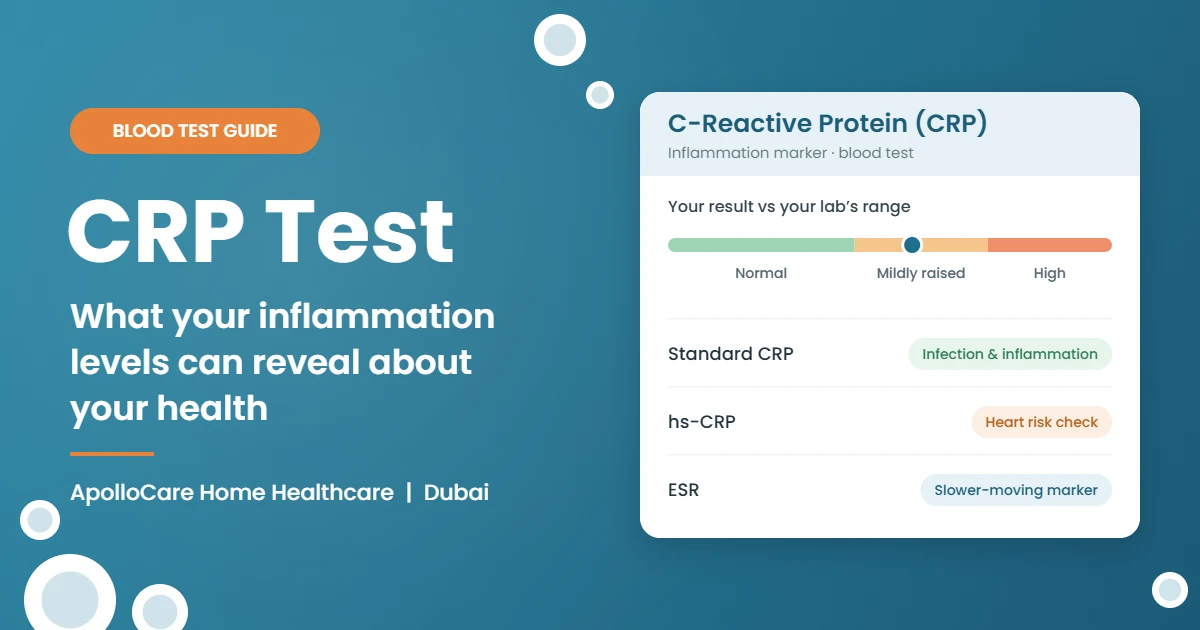
- Standard CRP looks for the larger rises seen with infection and active inflammation.
- High-sensitivity CRP (hs-CRP) picks up much lower levels. MedlinePlus notes it is used to help judge a person’s risk of heart disease.
For hs-CRP, MedlinePlus cites American Heart Association bands: below 1.0 mg/L suggests lower risk, 1.0 to 3.0 mg/L average risk, and above 3.0 mg/L higher risk. Even so, hs-CRP is never a heart test on its own. Doctors weigh it with blood pressure, cholesterol, diabetes, smoking and family history. If you’re not sure which one you had, check the test name on your report.
How to read your CRP test result
What counts as normal?
Results are usually reported in milligrams per litre (mg/L). Labs set their own reference ranges. Many use an upper limit for standard CRP somewhere around 5 to 10 mg/L, but always compare your number with the range printed on your own report.
A mildly raised result
A small rise is common and often temporary. A recent cold, a minor injury, smoking, carrying extra weight, poor sleep and some hormone treatments can all push CRP up a little. Your doctor may simply repeat the test once you’re well.
A clearly high result
A high CRP usually points to significant inflammation, often from a bacterial infection or an active inflammatory condition. It needs medical review, especially if you feel unwell. The number doesn’t make the diagnosis. The doctor’s assessment does.
A low or normal result
A normal CRP is usually reassuring, but it doesn’t rule everything out. Some conditions raise CRP only slightly. If your symptoms continue, keep your follow-up appointment.
CRP or ESR: what’s the difference?
Erythrocyte sedimentation rate (ESR) is another blood test for inflammation. CRP responds faster. It rises sooner and falls sooner once the cause is treated. ESR changes more slowly and is affected by things like anaemia and age. Doctors sometimes order both for a fuller picture, often together with a CBC test, which counts your white blood cells.
Do you need to prepare for a CRP test?
For a CRP test on its own, you usually don’t need to fast. But CRP is often bundled with tests that do need fasting, such as glucose or cholesterol. Follow the instructions you’re given for the whole panel. Our guide to blood test preparation at home covers the basics.
Tell your doctor about any medicines and supplements you take. Anti-inflammatory painkillers and steroids, for example, can affect inflammation markers and change how a result should be read. Don’t stop a prescribed medicine without speaking to your doctor first.
Having a CRP test at home in Dubai
For many families, getting to a clinic is the hardest part. Think of an older relative with limited mobility, a mother with a newborn, or someone recovering from surgery. A home visit takes that step away.
With a blood test at home in Dubai, a qualified phlebotomist collects the sample where you are. It’s processed by a DHA-approved laboratory, and most reports are ready within 24 to 48 hours, depending on the test. If a result is abnormal, a doctor on call can review it with you and explain what happens next. Under the Dubai Health Authority’s Standards for Home Healthcare Services, home healthcare professionals must be licensed and registered with DHA.
When not to wait for a test result
A CRP test is a planning tool, not an emergency check. Call 998 or go to the nearest emergency department if you or a family member has:
- Very fast breathing
- New confusion, slurred speech or not making sense
- Blue, pale or blotchy skin, lips or tongue
- A rash that doesn’t fade when you press on it
- A very high or very low temperature, or uncontrollable shivering
The NHS lists these among the warning signs of sepsis, a medical emergency. If you’re unsure whether a symptom needs a home visit or hospital care, our guide on doctor on call vs the emergency department can help.
Frequently asked questions
What is a normal CRP level?
It depends on the lab. Many laboratories treat standard CRP below roughly 5 to 10 mg/L as normal. Always use the reference range on your own report, and ask your doctor what your result means for you.
Do I need to fast before a CRP test?
Usually not, if CRP is the only test. If it’s part of a panel that includes fasting glucose or cholesterol, follow the fasting instructions for that panel.
Can stress or poor sleep raise CRP?
Poor sleep, depression and carrying extra weight are linked with slightly higher CRP levels. These rarely explain a clearly high CRP, which needs a medical look.
How quickly does CRP come down after an infection?
CRP usually starts falling within a few days once the cause is treated. That’s why doctors sometimes repeat the test to check progress.
Can a CRP test detect cancer?
No. CRP is not a cancer test. Many conditions can raise it, so it can’t point to any one disease.
Is hs-CRP the same as a CRP test?
They measure the same protein. hs-CRP detects much smaller amounts and is mainly used as one part of heart disease risk assessment.
The bottom line on the CRP test
A CRP test is a quick, useful signal that inflammation is present, but it’s only part of the story. Read your result against your lab’s range, look at it alongside your symptoms and other tests, and let a doctor interpret it.
If getting to a lab is difficult, ApolloCare’s DHA-licensed team can collect a blood test at home anywhere in Dubai. A doctor can then talk you through the results. Call +971 50 491 9347 or contact us to ask a question.
Disclaimer: This article is for general information and is not a substitute for medical advice. In an emergency, call 998.
